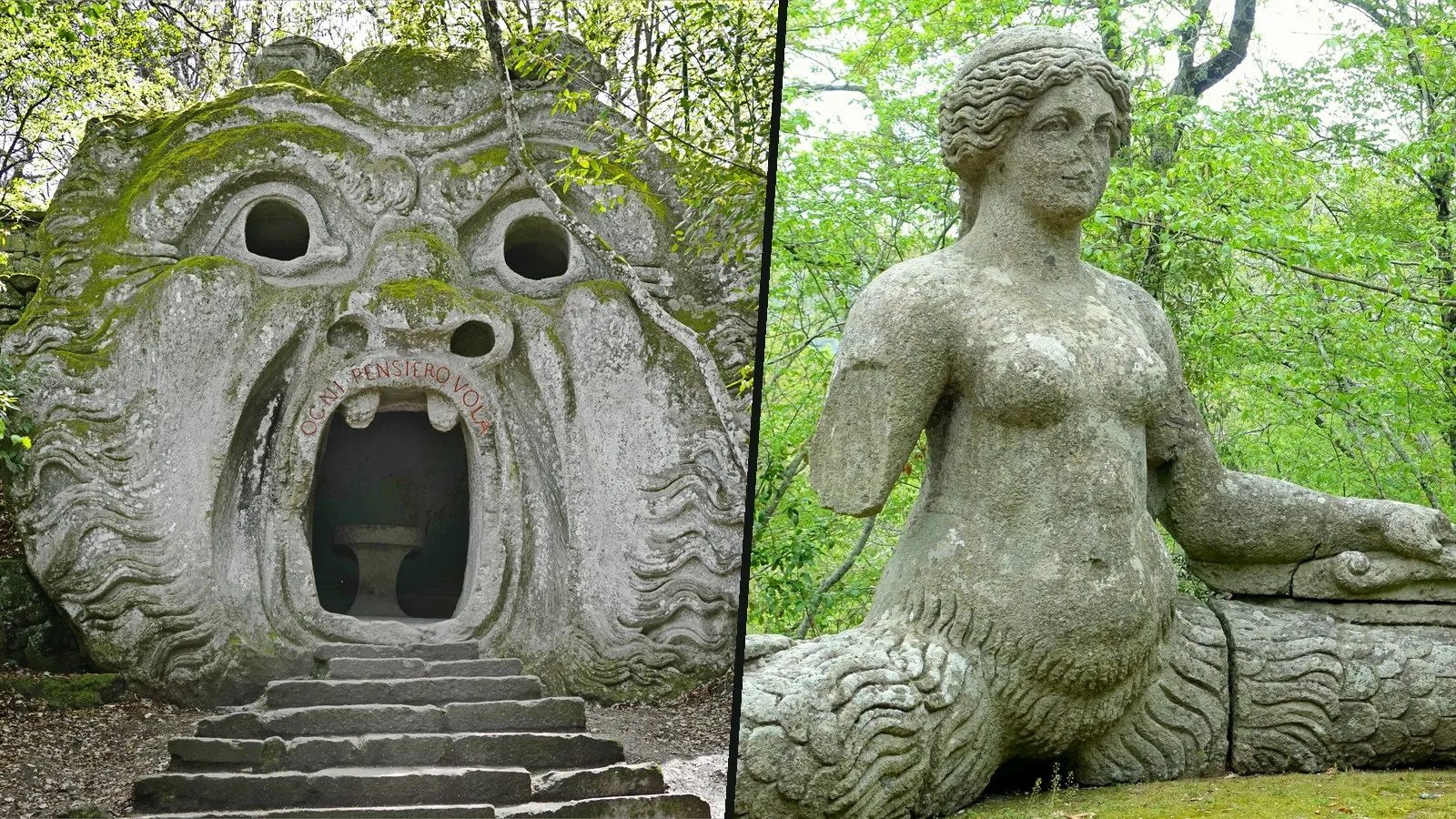
A forest built to astonish
In the mid-1500s, an Italian prince named Vicino Orsini filled a wooded valley with monsters. After his beloved wife, Giulia Farnese, died, he built a memorial temple to her among them. In a 1570 letter, he wrote that the Sacro Bosco gave him every sort of consolation in place of his dearest beloved.
Across the park stand giant screaming faces, a war elephant, a dragon and a house that leans on purpose. Then, for centuries, it lay abandoned. Today, the Sacro Bosco in Bomarzo, north of Rome, is known as the Park of Monsters. Here are 10 photos.
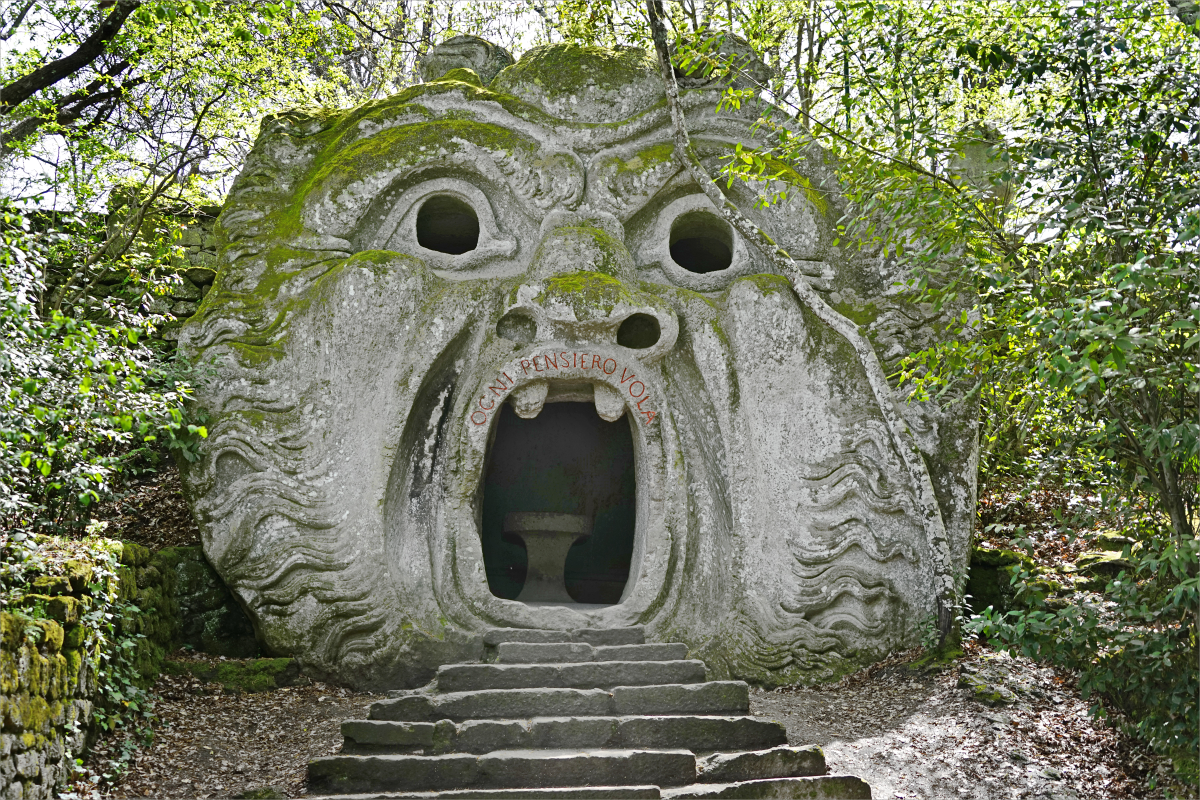
😱 “The Orcus” (Hell Mouth) — In the Park of Monsters, Bomarzo, Italy 🇮🇹
Carved straight out of a boulder, a screaming face stands as tall as a house. Its open mouth serves as a doorway, with steps inviting you to walk right in.
📂 Artwork File · Sourced factsOrcus (Hell Mouth)Commissioned by Vicino Orsini · 16th century · Sacro Bosco, BomarzoWalk-in sculptureStone table insideMap No. 221Its mouth opens into a small room with a stone table and benches.Naòs (2026)2According to Archaeology magazine, the room was designed as an open-air dining room, with the tongue as the table.Archaeology (2025)201814 AprPhoto: the open mouth and steps201822 JunPhoto: inside, looking out through the mouth20259 JunArchaeology: the Hell Mouth as a dining room2025SepListed as No. 22 on the park map20266 AprNaòs describes and pictures itRead the full file →
📷 Photo: Jean-Pierre Dalbéra / Wikimedia Commons (CC BY 2.0).
💡 Changed Words Fact: On its upper lip, the words now read “OGNI PENSIERO VOLA” (“Every thought flies”). Originally, Archaeology magazine notes, the inscription read “Abandon all thought, you who enter,” echoing Dante’s “Abandon all hope, you who enter.”
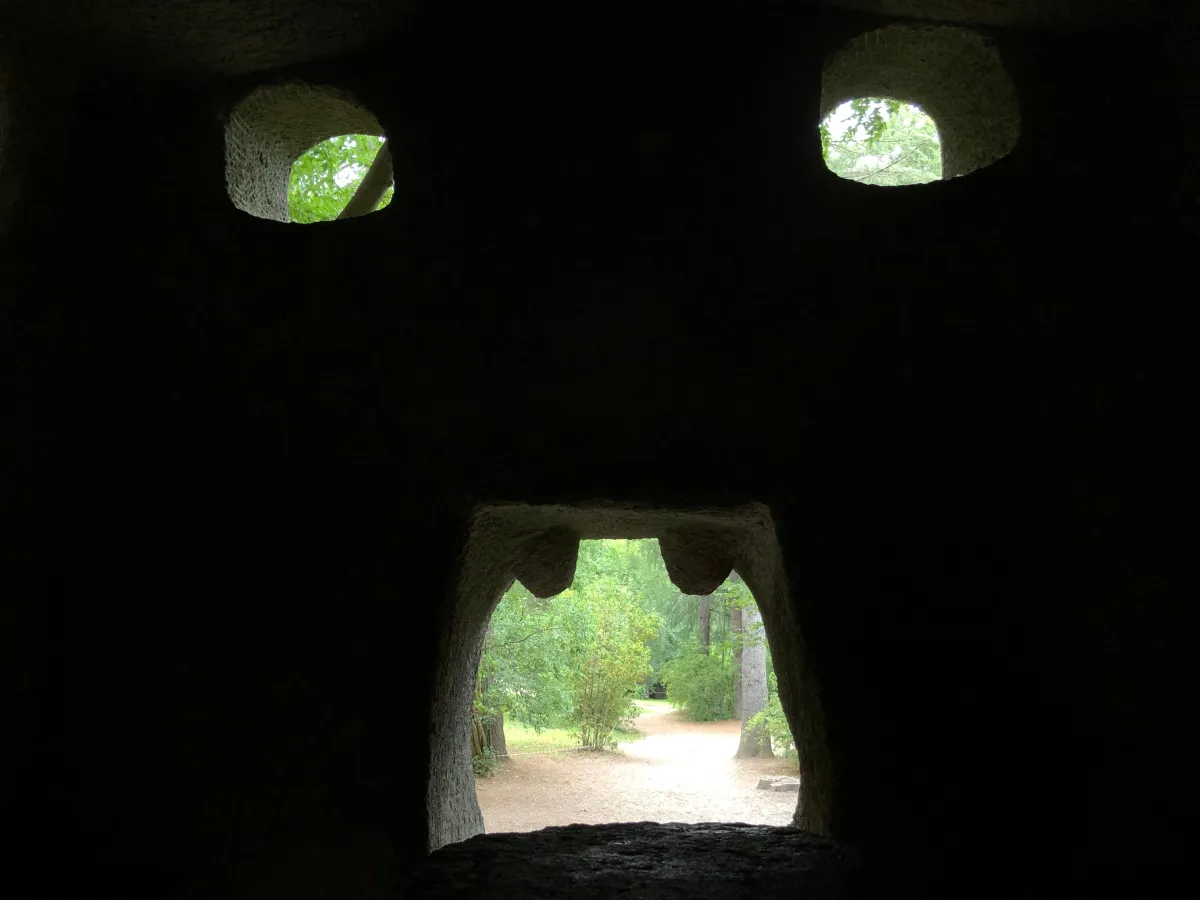
🍽️ Dinner Inside the Monster — In the Park of Monsters, Bomarzo, Italy 🇮🇹
From inside the ogre’s mouth, this is the view looking back out through its eyes and teeth, with the stone table at the bottom forming the monster’s tongue. A 16th-century visitor wrote that the teeth served as seats, and that at dinner, with candles lit, the face looked truly frightful from a distance.
📷 Photo: Davide Mauro / Wikimedia Commons (CC BY-SA 4.0).
💡 Eaten While Eating Fact: Guests really did dine in here. Art historian Luke Morgan calls it “The Hell Mouth” and notes the effect of eating and being eaten at the same time. The acoustics are strange too: a whisper inside carries clearly to anyone standing at the bottom of the steps, as Wikipedia reports.
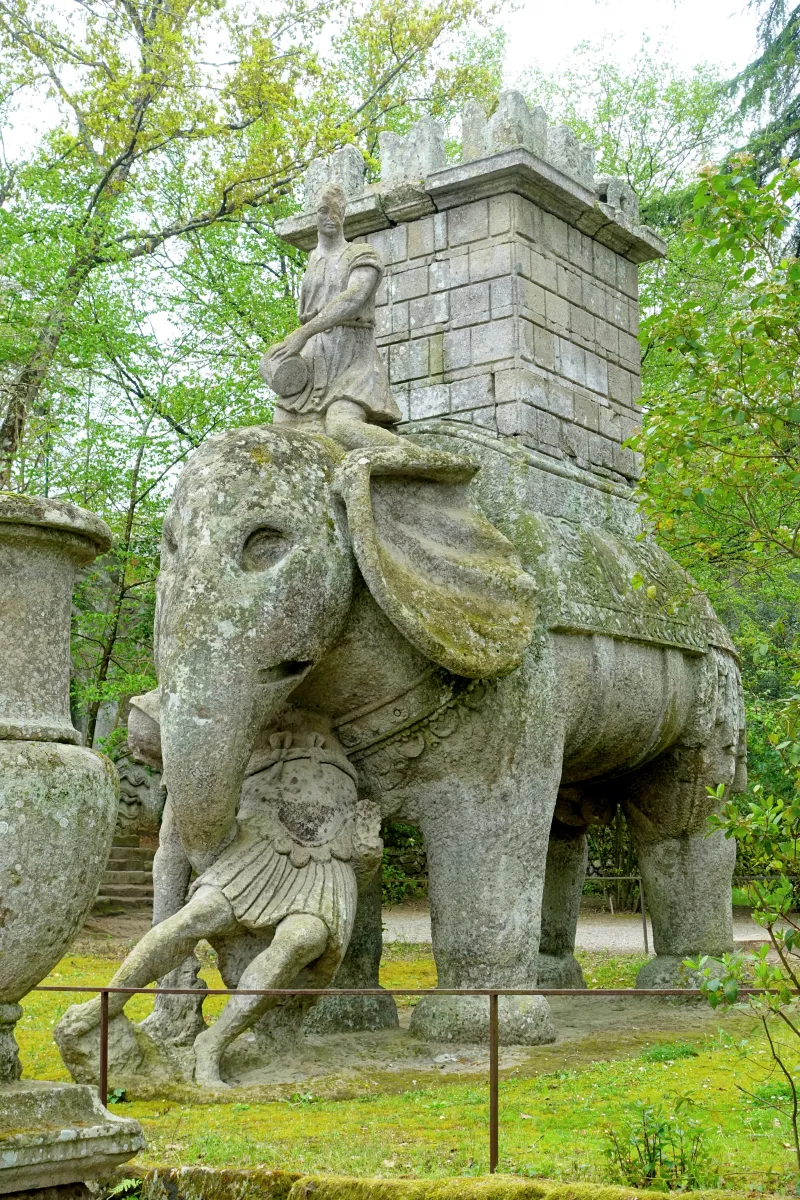
🐘 The War Elephant — In the Park of Monsters, Bomarzo, Italy 🇮🇹
Clad in battle armor and carrying a whole castle tower on its back, a huge elephant lifts a fallen soldier in its trunk.
📂 Artwork File · Sourced factsWar ElephantCommissioned by Vicino Orsini · 16th century · Sacro Bosco, BomarzoTower on its backSoldier in its trunkMap No. 241According to Naòs, the elephant lifts a Roman legionary gripped in its trunk.Naòs (2026)2APGI calls it the turreted elephant and places it right after the Dragon group.APGI201910 AprPhoto: tower, trunk and soldier2021MarRai Cultura: Hannibal’s elephant2025SepListed as No. 24 on the park map20266 AprNaòs describes and pictures itRead the full file →
📷 Photo: Daderot / Wikimedia Commons (Public domain).
💡 Family Loss Fact: As Finestre sull’Arte notes, the scene probably alludes to the death of Orsini’s son Orazio, who fell in the Battle of Lepanto.
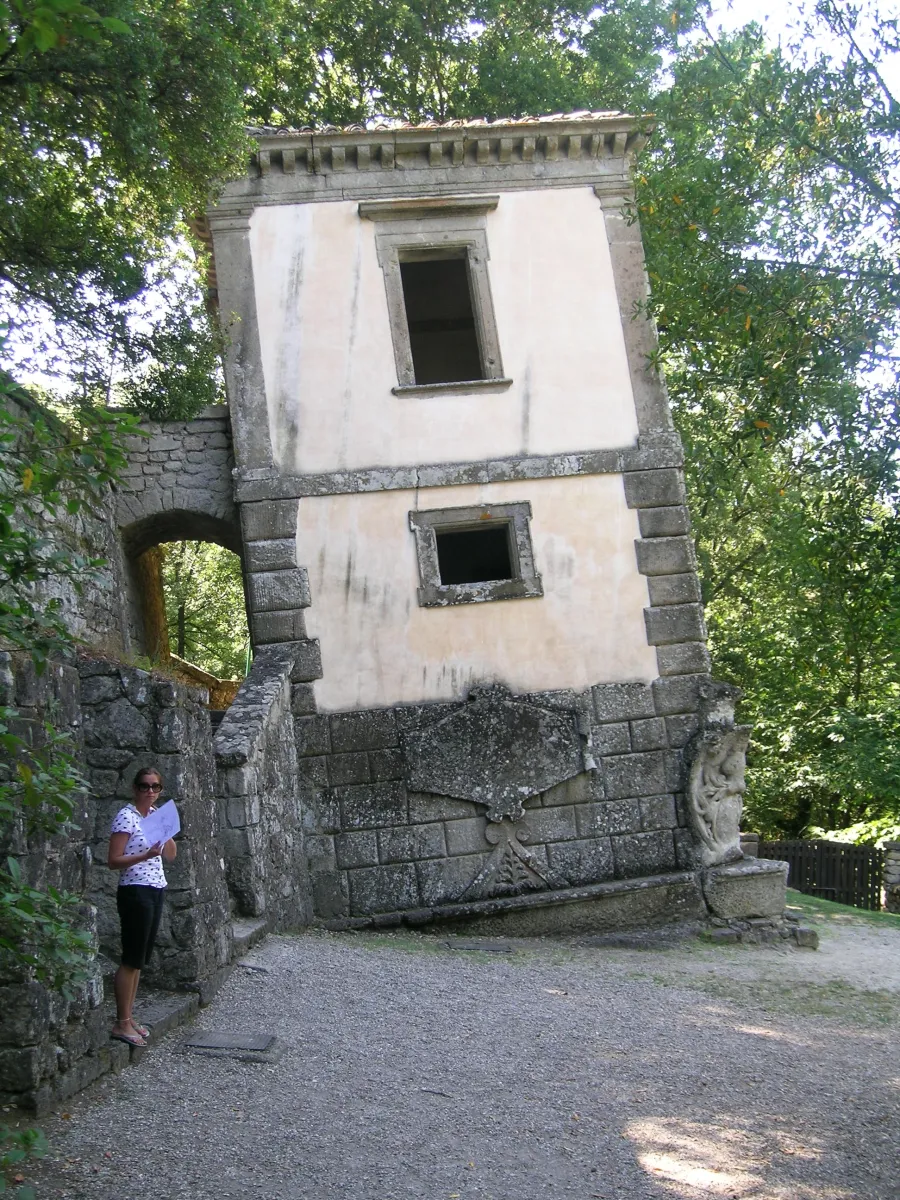
🏚️ “The Leaning House” — In the Park of Monsters, Bomarzo, Italy 🇮🇹
Built on a boulder and tilted on purpose, this is a real two-story house. Step inside, and your sense of balance goes haywire.
📂 Artwork File · Sourced factsLeaning House (Casa Pendente)Commissioned by Vicino Orsini · 16th century · Sacro Bosco, BomarzoCasa PendenteMap No. 171Italia.it says it stands on a boulder tilted at 23°, the same angle as the Earth’s axis.Italia.it2According to Naòs, the sloping walls and floor bring on vertigo as soon as you step inside.Naòs (2026)2008AugPhoto: the tilted house20259 JunArchaeology: a nod to earthquakes?2025SepListed as No. 17 on the park map20266 AprNaòs describes and pictures itRead the full file →
📷 Photo: Alessio Damato / Wikimedia Commons (CC BY-SA 3.0).
💡 Built Crooked Fact: The little house rests on a boulder tilted at 23 degrees.
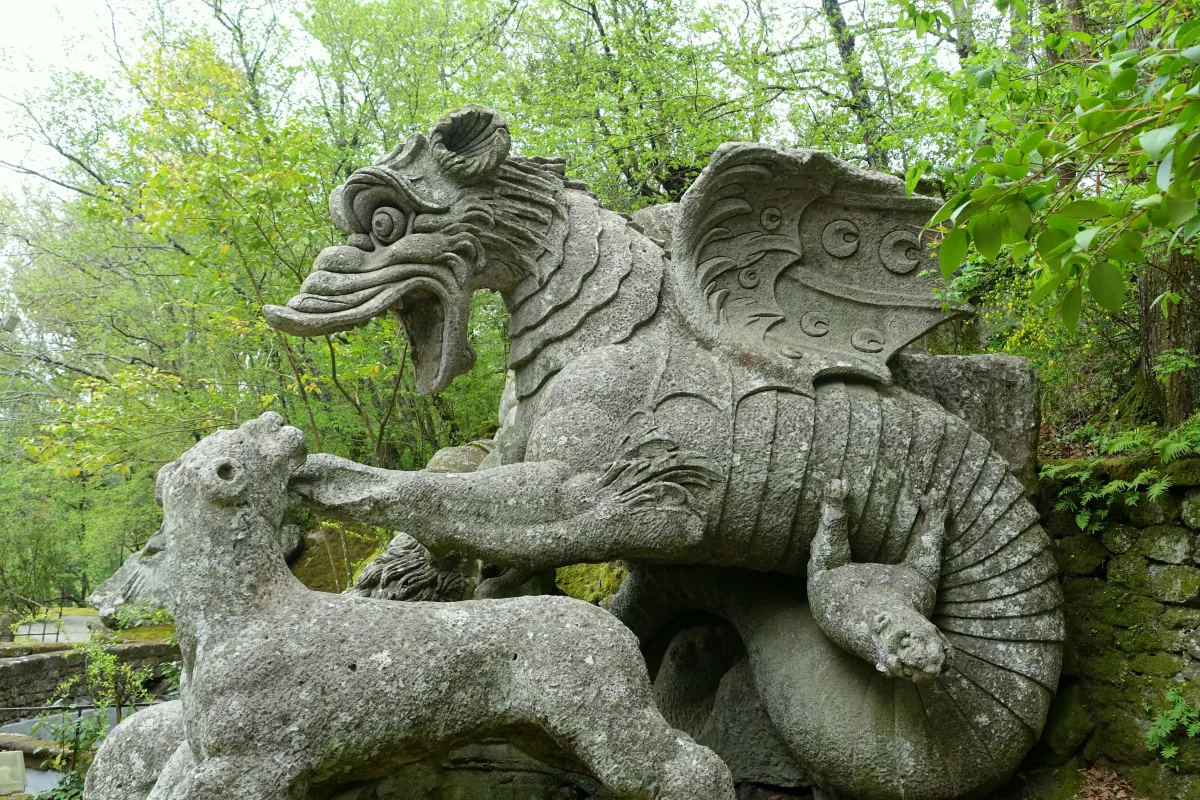
🐉 The Dragon Fighting Lions — In the Park of Monsters, Bomarzo, Italy 🇮🇹
Its jaws flaring, a winged dragon twists around to fight off the beasts attacking it from both sides.
📂 Artwork File · Sourced factsDragon Fighting LionsCommissioned by Vicino Orsini · 16th century · Sacro Bosco, BomarzoNext to the elephantMap No. 231According to Archaeology magazine, an enormous bug-eyed dragon fends off a pair of lions.Archaeology (2025)2Naòs instead names a dog, a lion and a wolf, read as spring, summer and winter.Naòs (2026)201910 AprPhoto: the dragon and a lion201922 AprPhoto: the other side, with the maned lion2021MarRai Cultura: the dragon fights a lion20259 JunArchaeology: two lions attack the dragon2025SepListed as No. 23 on the park map20266 AprNaòs: a dog, a lion and a wolfMore photos2019 The other side, with the maned lionPhoto: Memi26 / Wikimedia Commons (CC BY-SA 4.0)Read the full file →
📷 Photo: Daderot / Wikimedia Commons (Public domain).
💡 Mystery Fact: Nobody fully understands the monsters. One theory links them to the strange Renaissance romance Hypnerotomachia Poliphili, whose hero wanders a magic park full of creatures; others look for clues in events from Orsini’s own life, as JSTOR Daily explains.
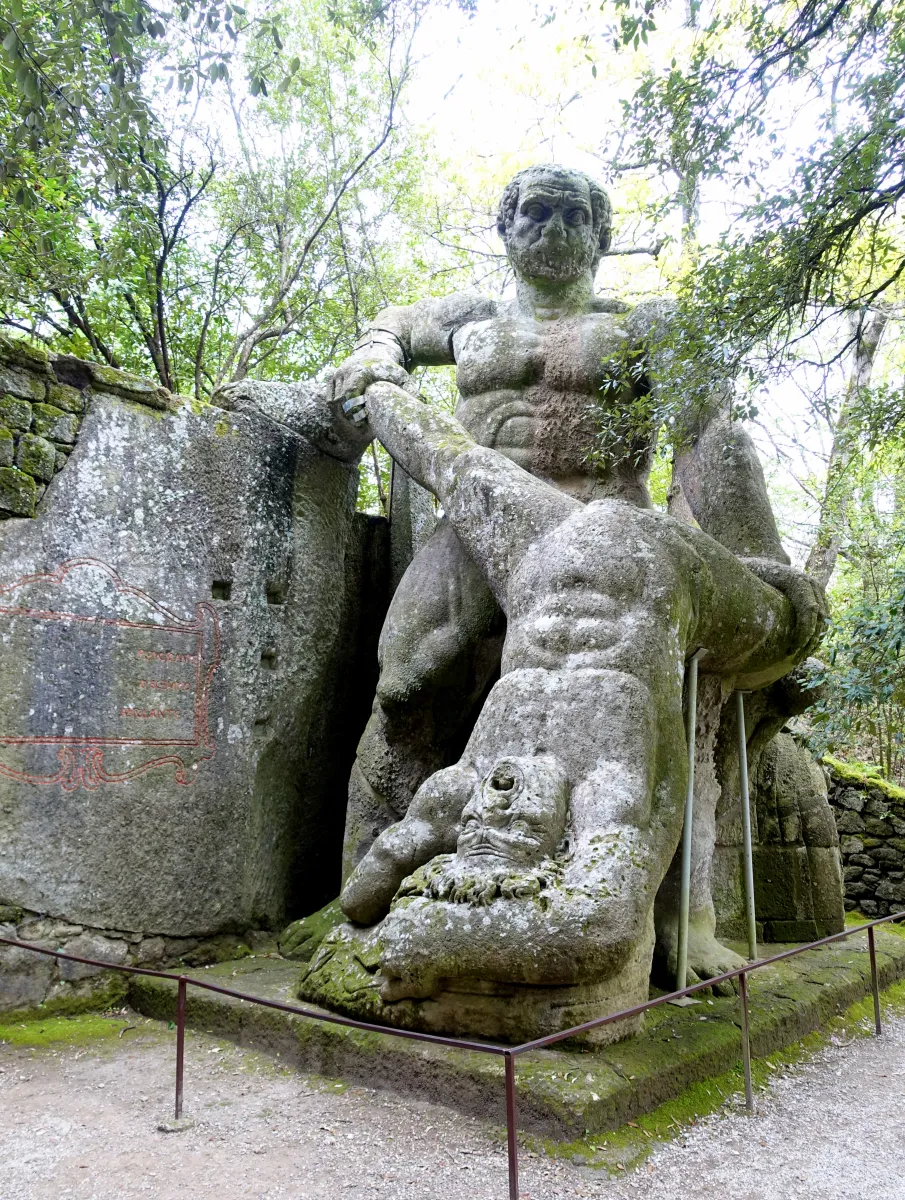
💪 The Fighting Giants (Hercules and Cacus) — In the Park of Monsters, Bomarzo, Italy 🇮🇹
One giant holds another upside down by the legs, poised to tear him in two.
📂 Artwork File · Sourced factsHercules and Cacus (the Fighting Giants)Commissioned by Vicino Orsini · 16th century · Sacro Bosco, BomarzoTwo giantsErcole e CacoMap No. 61Italia.it calls the pair Hercules and Cacus.Italia.it2According to Archaeology magazine, a likely source is Orlando Furioso, whose maddened hero tears a woodsman in two.Archaeology (2025)201910 AprPhoto: one giant holds the other upside down2021MarRai Cultura: Hercules kills Cacus20259 JunArchaeology: Orlando Furioso as a source2025SepListed as No. 6 on the park map20266 AprNaòs describes and pictures themRead the full file →
📷 Photo: Daderot / Wikimedia Commons (Public domain).
💡 Mad Knight Fact: Though the giants are usually called Hercules and Cacus, a worn inscription beside them mentions Anglante, home of the knight Orlando. In Ariosto’s epic poem Orlando Furioso, Orlando, driven mad by lost love, catches a woodsman by the legs and tears him in two, as art historian Annalisa Cignitti explains.
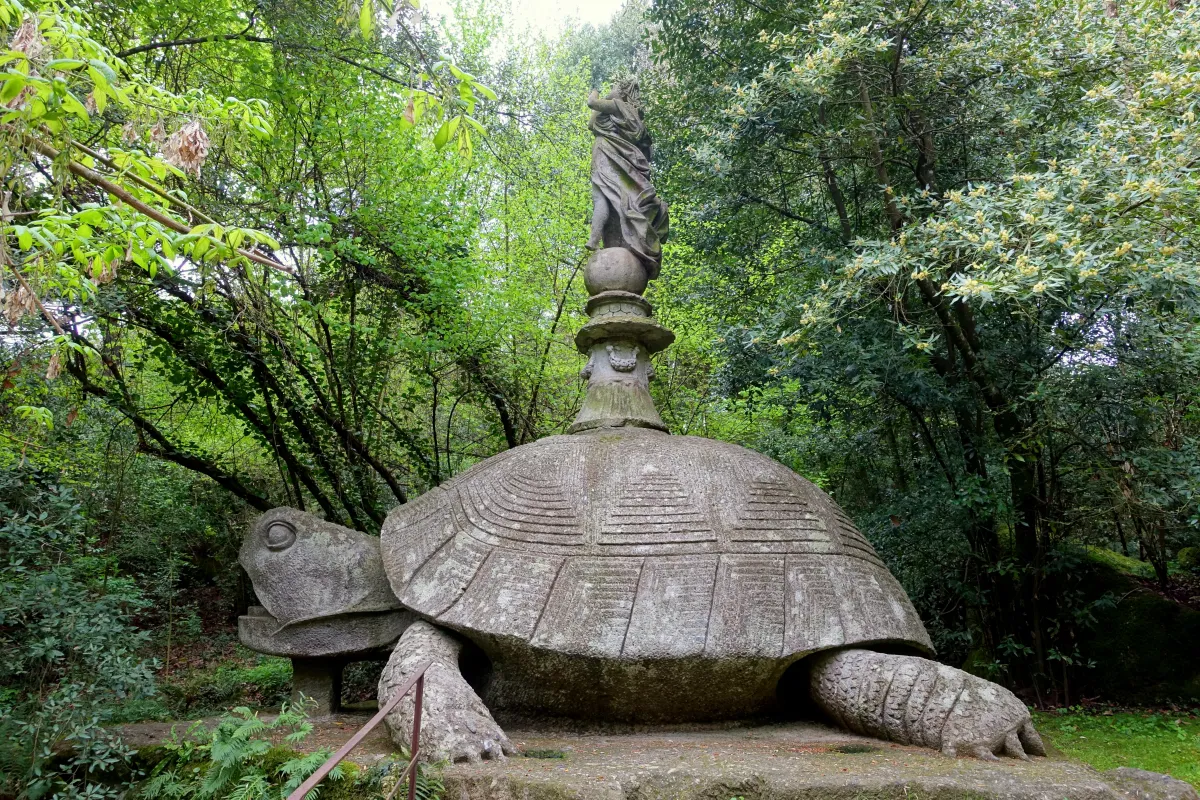
🐢 The Giant Turtle — In the Park of Monsters, Bomarzo, Italy 🇮🇹
Carrying a tall pedestal on its shell, a giant turtle crawls through the forest. On top stands a winged woman, usually read as Nike, the Greek goddess of victory, though some suggest she may be Fame.
📂 Artwork File · Sourced factsGiant TurtleCommissioned by Vicino Orsini · 16th century · Sacro Bosco, BomarzoFemale figure on topFaces the whaleMap No. 71Italia.it says Nike, the goddess of victory, stands on the turtle.Italia.it2According to Naòs, the figure represents Fame, and the turtle looks down toward the whale.Naòs (2026)201910 AprPhoto: the turtle and the figure on its shell2021MarRai Cultura: an enormous turtle20259 JunArchaeology: perhaps the goddess Fame2025SepListed as No. 7 on the park map20266 AprNaòs describes and pictures itRead the full file →
📷 Photo: Daderot / Wikimedia Commons (Public domain).

🐋 The Whale — In the Park of Monsters, Bomarzo, Italy 🇮🇹
Beside a little stream, a toothy whale surfaces from the rocks, covered in moss after more than 400 years.
📂 Artwork File · Sourced factsWhale (Orca)Commissioned by Vicino Orsini · 16th century · Sacro Bosco, BomarzoOrca on the mapFaces the turtleMap No. 81The official park map lists the sculpture as “Orca”.Official park map2According to Naòs, it rises from the water and threatens the turtle with its open mouth and sharp teeth.Naòs (2026)20241 AprPhoto: the whale beside the stream20259 JunArchaeology: a killer whale erupts from the earth2025SepListed as No. 8, Orca, on the park map20266 AprNaòs describes and pictures itRead the full file →
📷 Photo: Albarubescens / Wikimedia Commons (CC BY-SA 4.0).
💡 Lost Forest Fact: After Orsini died in 1585, the park was left abandoned. In the second half of the 20th century, Giancarlo and Tina Severi Bettini restored it.

🌊 Proteus, the Sea Monster — In the Park of Monsters, Bomarzo, Italy 🇮🇹
With its mouth wide open, a gigantic head rises out of the ground, balancing a globe and a tiny castle atop its skull.
📂 Artwork File · Sourced factsProteus-GlaucusCommissioned by Vicino Orsini · 16th century · Sacro Bosco, BomarzoGlobe and castleProteo-GlaucoMap No. 31The official park map names it Proteo-Glauco, Proteus-Glaucus.Official park map2According to Naòs, the globe on his head bears the Orsini emblem and is topped by the castle of Bomarzo.Naòs (2026)201910 AprPhoto: the head, globe and castle2025SepListed as No. 3 on the park map20266 AprNaòs describes itRead the full file →
📷 Photo: Daderot / Wikimedia Commons (Public domain).
💡 Shape-Shifter Fact: In the Italian art magazine Finestre sull’Arte, the head is identified as Proteus-Glaucus, a sea being from Greek mythology known for his ability to change form.

🐍 Echidna, Mother of Monsters — In the Park of Monsters, Bomarzo, Italy 🇮🇹
With two huge serpent tails instead of legs, a woman lounges on the lawn as if she owns the whole forest.
📂 Artwork File · Sourced factsEchidnaCommissioned by Vicino Orsini · 16th century · Sacro Bosco, BomarzoSerpent tailsTwo lionsMap No. 341Italia.it describes her as a woman with a snake’s tail instead of legs.Italia.it2The official map lists the Lions (No. 33) right before Echidna (No. 34).Official park map201910 AprPhoto: Echidna and her two tails201922 AprPhoto: Echidna with the two lions20259 JunArchaeology: a siren with two tails and two lions2025SepListed as No. 34 on the park mapMore photos2019 With the two lions beside herPhoto: Memi26 / Wikimedia Commons (CC BY-SA 4.0)Read the full file →
📷 Photo: Daderot / Wikimedia Commons (Public domain).
💡 Surrealist Fact: As Atlas Obscura recounts, Salvador Dalí visited the park and loved it, and its sculptures are said to have inspired his painting The Temptation of Saint Anthony.
Scholars still debate what it all means. Orsini himself left one hint: one of his inscriptions says the Sacro Bosco resembles only itself and nothing else.


